
Just the facts from the Encyclopaedia Britannica:
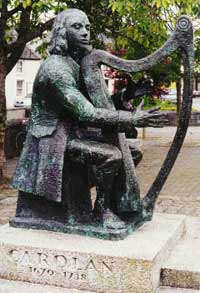
Turlough O'Carolan, also called Terence Carolan (born 1670, near Nobber, County Meath, Ireland, died March 25th, 1738,
Alderford, County Roscommon), one of the last Irish harpist-composers and the only one whose songs survive in both words
and music in significant number (about 220 of provable provenance are extant with an uncounted number apocryphally
attributed).
The son of an iron founder, O'Carolan became blind from smallpox at the age of 18. He was befriended by a Mrs. MacDermott-
Roe, the wife of his father's employer, who apprenticed him to a harper and supported him for the three years of his training,
then gave him money, a guide, and a horse.
As an itinerant harper, he traveled widely in Ireland. Although never considered a master performer, he was highly regarded as a
composer of songs and improvised verse. His tunes appeared widely in 18th-century collections.
A rather more ornate description comes from the pages of "Irish Culture and Customs".
Tribute to Turlough O'Carolan
by Bridget Haggerty
"When Turlough O'Carolan died at the house of his patron Máire MacDermott Roe
in 1738, his former music-pupil Charles O'Conor recorded his passing in sadness:
'Saturday, the 25th day of March, 1738. Turlough O'Carolan, the wise master and
chief musician of the whole of Ireland, died today and was buried in the
O'Duignan's church of Kilronan, in the sixty-eighth year of his age. May his
soul find mercy, for he was a moral and religious man.'
"Toirdhealbhach Ó Cearbhalláin was born 1670 near Nobber, County Meath.
In English, his name was Terence Carolan. Some sources say his father was a
blacksmith (An iron founder according to Britannica), others say he was a farmer
(New Grove Dictionary of Music and Musicians). Whatever his trade - perhaps he
was both farmer and blacksmith - John Ó Cearbhalláin moved his family to
Ballyfarnon to take employment with the MacDermott Roe family. His son,
Turlough, was 14 years old.
"Mrs. MacDermott liked the boy and saw to it that he was educated. Observing
that he appeared to have a talent for music and poetry, she also arranged for him
to have lessons on the harp. When he was about 18, he was stricken with
smallpox which left him completely blind. However, this handicap did not stop
his studies, and after three years, Mrs. MacDermott gave him a harp, a horse, a
guide, and the money to launch a career as an itinerant harper, playing for patrons
throughout the Irish countryside.
"His first patron was George Reynolds of County Leitrim who suggested that
Carolan - as he was known to himself and his friends - try his hand at composition.
With this encouragement, Carolan composed 'Si Bheag, Si Mhor,' which
means ' Big Hill, Little Hill,' and refers to a site in Co. Meath where, according
to folklore, two battling giants were turned by a wizard into two hills. To this day,
the tune is still closely associated with Carolan, the composer. Thereafter,
Carolan composed tunes for most of his patrons, usually putting them together
on his journeys.
"But what of the man himself? Various sources say that he was cheerful
and gregarious, enjoyed ludicrous stories, practical jokes and, according
to one biographer - Donal O'Sullivan - he was an excellent
backgammon player. As with many harpers of the time, he also drank
a great deal, and he had a temper.
"Several anecdotes gleaned from our research colorfully illustrate these
characteristics. A doctor advised Carolan to stop drinking for a period
of time. Carolan began to feel worse instead of better. He then found
a doctor who gave him the opposite advice, whereupon Carolan spirits
immediately became 'lively and cheerful'. He composed the following
verse, translated from the Gaelic:
He's a fool who gives over the liquor,
It softens the skinflint at once,
It urges the slow coach on quicker,
Gives spirit and brains to the dunce.
The man who is dumb as a rule
Discovers a great deal to say,
While he who is bashful since Yule
Will talk in an amorous way.
It's drink that uplifts the poltroon
To give battle in France and in Spain,
Now here is an end of my tune-
And fill me that bumper again!
"Among the more than 220 compositions still played today, 'Farewell
to Whiskey' is about the aftermath of the one doctor forbidding him
to drink anymore, and 'O'Carolan's Receipt' is about getting a
prescription from the other doctor to go back to drinking whiskey
again! According to the biographers, he stayed up all night with the
doctor (Doctor John Stafford) and wrote the tune in his honor.
"In another anecdote, it was said that David Murphy, who was harper
to Lord Mayo and once played before King Louis XIV of France, told
Carolan his tunes were like 'bones without beef'. Carolan
thereupon dragged Murphy kicking and screaming through the
room. While Murphy screamed, Carolan remarked, 'Put beef to
that air, you puppy.'
"Carolan composed music and verse for some of the greatest families
in the country. While a product of Gaelic Ireland, to a remarkable
degree he appealed as much to the Gael as to the Planter. The names
of those for whom he composed included Coote, Cooper, Crofton,
Brabazon, Pratt, in addition to O'Hara, Irwin, Betagh, Stafford
and Blayney, all of them Protestant. But, he also composed
for well-known Papist families.
"His poem in praise of Eleanor Plunkett of Robertstown highlights
her descent from the renowned Plunketts of Ardamagh. He addresse
her as 'a ghaoil na bhfear éachtach O Ardamacha bréige' -
'0 relation of the men of great deeds from Ardamagh of Bregia.'
The Plunketts had long held the stronghold of Castle Cam in
Ardamagh. Yet the poem goes on to observe that now only Eleanor
of all her relations survives in the area. The Plunketts, as with
many other Papist families, lost their lands in the Cromwellian
plantation.
"The Cruise family, too, figures prominently in his works. He
is said to have fallen in love with Brigid Cruise in whose
honour he composed no less than four songs of praise. Legend
has it that many years later, on a pilgrimage to Lough Derg,
he recognised her by the touch of her hand.
"Surprisingly, at least to this writer, Carolan was never highly
regarded as a performer. His fame came from his gift for musical
composition and poetry and his usual method was to compose
the tune first and then write the words. This was the opposite
of traditional Irish practice. While music had always been held
in high esteem, prior to Carolan, poetry always took precedence.
I"n Carolan's time, there were three musical traditions in Ireland
- art music, folk music, and the harper tradition. The harper
tradition served as a link between art and folk music and was
the main conduit for the oral tradition. Carolan created a
unique style by combining these art forms, and then adding
elements inspired by Italian music which was then fashionable
in Ireland. He was a great admirer of Vivaldi and Corelli,
whose modern music he would have heard in the homes of
his noble Irish patrons, and this admiration is reflected in
the melodic construction and forms of many of his pieces.
In fact, it's said that his 'Carolan's Concerto' was a winning
response to a compositional challenge from Geminiani,
an acquaintance, colleague, and contemporary.
"When he was in Dublin, Carolan was the frequent guest of
Dr. Patrick Delany, Professor of Oratory at Trinity College,
in whose honour he composed a tune. Through Delany he came
in contact with Jonathan Swift. Swift and O'Carolan
collaborated in translating a poem by Carolan's friend,
Hugh Magauran, 'Pléaraca na Ruarcach' or 'O'Rourke's Feast,'
for which Carolan wrote the music.
"A collection of Carolan's tunes was published in his own lifetime,
possibly in 1721, by John and William Neale of Dublin, an
extraordinary achievement for an Irish harpist at the height
of the penal laws. The National Library of Ireland has the only copy.
"Definitely a lover of whiskey, women and wit, Carolan did finally
settle down and marry Mary Maguire. They lived on a farm near
Mohill, Co. Leitrim and had seven children. Mary died in 1733
and just five years later, feeling ill, Carolan returned to the home
of Mrs. MacDermott Roe. After several days, he called for a drink
and repeated these lines to his first patron:
Mary Fitzgerald, dear heart,
Love of my breast and my friend,
Alas that I am parting from you,
O lady who succored me at every stage.
"His final composition was to the butler, Flinn, who brought him his
last drink. And, in a final fitting salute, his wake lasted four days.
"According to musician Chris Smith, 'Carolan's tunes are not like
other tunes in the Irish folk tradition. In them, we can hear the two
halves of Carolan's personality: the inheritor of the tradition of
the Irish bards, whose social prestige and respect were so great
that they sat at the tables of kings, and then the wandering
musicians who came later. We can hear Carolan reaching toward
the Italian style, but without leaving behind the folk roots of the
Irish tradition.'
"He was an Irish icon, written of by Oliver Goldsmith in 1760, arranged
by Beethoven about 1809, and he appears on the old Irish 50 pound note.
As comfortable in the raucous company of McGrattan's Pub as he was
playing for the landed gentry of the grand Irish estates, Grainne Yeats
sums up her biography with an excellent tribute:
"Carolan bridges the gap between continental art music on the one hand,
and the Gaelic harp and folk music on the other. At his best he wrote
music that is distinctively Irish, yet has an international flavor as well.
It is this achievement that suggests that Turlough Carolan does indeed
deserve the title of Ireland's 'National Composer.' "
Sources:
The Encyclopedia Britannica
Carolan: The Life and Times of an Irish Harper by Donal O'Sullivan
Contemplator.net
Harp.Net
Portrait: The National Gallery of Ireland Painted from Life.
Artist Unknown (From the cover of Derek Ball's CD)
I unabashedly admit to swiping the above, (almost) entire. Lovely job, Bridget! Follow this link for more Irish materials on the
pages "bashed, kicked and glued together by Russ Haggerty". Russ, I feel your pain!
Turlough O'Carolan, also called Terence Carolan (born 1670, near Nobber, County Meath, Ireland, died March 25th, 1738,
Alderford, County Roscommon), one of the last Irish harpist-composers and the only one whose songs survive in both words
and music in significant number (about 220 of provable provenance are extant with an uncounted number apocryphally
attributed).
The son of an iron founder, O'Carolan became blind from smallpox at the age of 18. He was befriended by a Mrs. MacDermott-
Roe, the wife of his father's employer, who apprenticed him to a harper and supported him for the three years of his training,
then gave him money, a guide, and a horse.
As an itinerant harper, he traveled widely in Ireland. Although never considered a master performer, he was highly regarded as a
composer of songs and improvised verse. His tunes appeared widely in 18th-century collections.
A rather more ornate description comes from the pages of "Irish Culture and Customs".
Tribute to Turlough O'Carolan
by Bridget Haggerty
"When Turlough O'Carolan died at the house of his patron Máire MacDermott Roe
in 1738, his former music-pupil Charles O'Conor recorded his passing in sadness:
'Saturday, the 25th day of March, 1738. Turlough O'Carolan, the wise master and
chief musician of the whole of Ireland, died today and was buried in the
O'Duignan's church of Kilronan, in the sixty-eighth year of his age. May his
soul find mercy, for he was a moral and religious man.'
"Toirdhealbhach Ó Cearbhalláin was born 1670 near Nobber, County Meath.
In English, his name was Terence Carolan. Some sources say his father was a
blacksmith (An iron founder according to Britannica), others say he was a farmer
(New Grove Dictionary of Music and Musicians). Whatever his trade - perhaps he
was both farmer and blacksmith - John Ó Cearbhalláin moved his family to
Ballyfarnon to take employment with the MacDermott Roe family. His son,
Turlough, was 14 years old.
"Mrs. MacDermott liked the boy and saw to it that he was educated. Observing
that he appeared to have a talent for music and poetry, she also arranged for him
to have lessons on the harp. When he was about 18, he was stricken with
smallpox which left him completely blind. However, this handicap did not stop
his studies, and after three years, Mrs. MacDermott gave him a harp, a horse, a
guide, and the money to launch a career as an itinerant harper, playing for patrons
throughout the Irish countryside.
"His first patron was George Reynolds of County Leitrim who suggested that
Carolan - as he was known to himself and his friends - try his hand at composition.
With this encouragement, Carolan composed 'Si Bheag, Si Mhor,' which
means ' Big Hill, Little Hill,' and refers to a site in Co. Meath where, according
to folklore, two battling giants were turned by a wizard into two hills. To this day,
the tune is still closely associated with Carolan, the composer. Thereafter,
Carolan composed tunes for most of his patrons, usually putting them together
on his journeys.
"But what of the man himself? Various sources say that he was cheerful
and gregarious, enjoyed ludicrous stories, practical jokes and, according
to one biographer - Donal O'Sullivan - he was an excellent
backgammon player. As with many harpers of the time, he also drank
a great deal, and he had a temper.
"Several anecdotes gleaned from our research colorfully illustrate these
characteristics. A doctor advised Carolan to stop drinking for a period
of time. Carolan began to feel worse instead of better. He then found
a doctor who gave him the opposite advice, whereupon Carolan spirits
immediately became 'lively and cheerful'. He composed the following
verse, translated from the Gaelic:
He's a fool who gives over the liquor,
It softens the skinflint at once,
It urges the slow coach on quicker,
Gives spirit and brains to the dunce.
The man who is dumb as a rule
Discovers a great deal to say,
While he who is bashful since Yule
Will talk in an amorous way.
It's drink that uplifts the poltroon
To give battle in France and in Spain,
Now here is an end of my tune-
And fill me that bumper again!
"Among the more than 220 compositions still played today, 'Farewell
to Whiskey' is about the aftermath of the one doctor forbidding him
to drink anymore, and 'O'Carolan's Receipt' is about getting a
prescription from the other doctor to go back to drinking whiskey
again! According to the biographers, he stayed up all night with the
doctor (Doctor John Stafford) and wrote the tune in his honor.
"In another anecdote, it was said that David Murphy, who was harper
to Lord Mayo and once played before King Louis XIV of France, told
Carolan his tunes were like 'bones without beef'. Carolan
thereupon dragged Murphy kicking and screaming through the
room. While Murphy screamed, Carolan remarked, 'Put beef to
that air, you puppy.'
"Carolan composed music and verse for some of the greatest families
in the country. While a product of Gaelic Ireland, to a remarkable
degree he appealed as much to the Gael as to the Planter. The names
of those for whom he composed included Coote, Cooper, Crofton,
Brabazon, Pratt, in addition to O'Hara, Irwin, Betagh, Stafford
and Blayney, all of them Protestant. But, he also composed
for well-known Papist families.
"His poem in praise of Eleanor Plunkett of Robertstown highlights
her descent from the renowned Plunketts of Ardamagh. He addresse
her as 'a ghaoil na bhfear éachtach O Ardamacha bréige' -
'0 relation of the men of great deeds from Ardamagh of Bregia.'
The Plunketts had long held the stronghold of Castle Cam in
Ardamagh. Yet the poem goes on to observe that now only Eleanor
of all her relations survives in the area. The Plunketts, as with
many other Papist families, lost their lands in the Cromwellian
plantation.
"The Cruise family, too, figures prominently in his works. He
is said to have fallen in love with Brigid Cruise in whose
honour he composed no less than four songs of praise. Legend
has it that many years later, on a pilgrimage to Lough Derg,
he recognised her by the touch of her hand.
"Surprisingly, at least to this writer, Carolan was never highly
regarded as a performer. His fame came from his gift for musical
composition and poetry and his usual method was to compose
the tune first and then write the words. This was the opposite
of traditional Irish practice. While music had always been held
in high esteem, prior to Carolan, poetry always took precedence.
I"n Carolan's time, there were three musical traditions in Ireland
- art music, folk music, and the harper tradition. The harper
tradition served as a link between art and folk music and was
the main conduit for the oral tradition. Carolan created a
unique style by combining these art forms, and then adding
elements inspired by Italian music which was then fashionable
in Ireland. He was a great admirer of Vivaldi and Corelli,
whose modern music he would have heard in the homes of
his noble Irish patrons, and this admiration is reflected in
the melodic construction and forms of many of his pieces.
In fact, it's said that his 'Carolan's Concerto' was a winning
response to a compositional challenge from Geminiani,
an acquaintance, colleague, and contemporary.
"When he was in Dublin, Carolan was the frequent guest of
Dr. Patrick Delany, Professor of Oratory at Trinity College,
in whose honour he composed a tune. Through Delany he came
in contact with Jonathan Swift. Swift and O'Carolan
collaborated in translating a poem by Carolan's friend,
Hugh Magauran, 'Pléaraca na Ruarcach' or 'O'Rourke's Feast,'
for which Carolan wrote the music.
"A collection of Carolan's tunes was published in his own lifetime,
possibly in 1721, by John and William Neale of Dublin, an
extraordinary achievement for an Irish harpist at the height
of the penal laws. The National Library of Ireland has the only copy.
"Definitely a lover of whiskey, women and wit, Carolan did finally
settle down and marry Mary Maguire. They lived on a farm near
Mohill, Co. Leitrim and had seven children. Mary died in 1733
and just five years later, feeling ill, Carolan returned to the home
of Mrs. MacDermott Roe. After several days, he called for a drink
and repeated these lines to his first patron:
Mary Fitzgerald, dear heart,
Love of my breast and my friend,
Alas that I am parting from you,
O lady who succored me at every stage.
"His final composition was to the butler, Flinn, who brought him his
last drink. And, in a final fitting salute, his wake lasted four days.
"According to musician Chris Smith, 'Carolan's tunes are not like
other tunes in the Irish folk tradition. In them, we can hear the two
halves of Carolan's personality: the inheritor of the tradition of
the Irish bards, whose social prestige and respect were so great
that they sat at the tables of kings, and then the wandering
musicians who came later. We can hear Carolan reaching toward
the Italian style, but without leaving behind the folk roots of the
Irish tradition.'
"He was an Irish icon, written of by Oliver Goldsmith in 1760, arranged
by Beethoven about 1809, and he appears on the old Irish 50 pound note.
As comfortable in the raucous company of McGrattan's Pub as he was
playing for the landed gentry of the grand Irish estates, Grainne Yeats
sums up her biography with an excellent tribute:
"Carolan bridges the gap between continental art music on the one hand,
and the Gaelic harp and folk music on the other. At his best he wrote
music that is distinctively Irish, yet has an international flavor as well.
It is this achievement that suggests that Turlough Carolan does indeed
deserve the title of Ireland's 'National Composer.' "
Sources:
The Encyclopedia Britannica
Carolan: The Life and Times of an Irish Harper by Donal O'Sullivan
Contemplator.net
Harp.Net
Portrait: The National Gallery of Ireland Painted from Life.
Artist Unknown (From the cover of Derek Ball's CD)
I unabashedly admit to swiping the above, (almost) entire. Lovely job, Bridget! Follow this link for more Irish materials on the
pages "bashed, kicked and glued together by Russ Haggerty". Russ, I feel your pain!


| (Site constructed 2003 - 2006 Rescued and revised 2015) |